Wednesday, June 26, 2019

Cuba's long forgotten Jewish cemetery, Holocaust monument getting restored

Cuba's long forgotten Jewish cemetery, Holocaust monument getting restored


Cuba's oldest Jewish cemetery undergoing historical restoration

As part of historical restoration efforts ahead of Havana's 500th anniversary, Cuba's oldest Jewish cemetery is getting some much-needed attention. Left in disrepair after Jewish families fled the Communist nation after the 1959 revolution, nearly 50 of the 1,110 Jewish graves have been restored, with plans to restore an additional 150 by the end of 2019.
The oldest Jewish cemetery in Cuba for decades had fallen into disrepair. Marble grave markers are broken, many taken over by plants.
But now, there is a major effort to spruce it up.
Many Jewish families left the Communist country after the 1959 revolution, leaving their dead in accordance with Jewish custom that prohibits bodies from being exhumed unless they are taken to their homeland in Israel. Others abandoned religious traditions amid deep secularism that took hold during the first few years of the Castro government or moved to Israel amid the periodic economic crunches in ensuing decades.
"The people buried here escaped fascism during the war. They're the founders of the community who bought these lands to make it a cemetery," David Prinstein, vice president of the Hebrew board, told the Associated Press. "It has historical and sentimental value."
CORRECTS THE NAME OF THE WAR - The portrait of a young Cuban soldier who died fighting in The Korean War decorates his tomb at a Jewish cemetery in Guanabacoa, eastern Havana, Cuba, June 7, 2019. Many Jewish families left the country after the 1959 revolution, leaving behind their dead in accordance with Jewish custom that prohibits bodies from being exhumed unless they are taken to Israel. (AP Photo/Ramon Espinosa)
About 50 of the 1,100 graves have been restored and a government official says they expect about 150 more to be completed before the end of the year.
The restoration of the Havana cemetery is part of the government-run city historian's office to spruce up Havana ahead of the 500th anniversary of its founding in November and comes at a time when Cuba finds itself struggling with a severe economic crisis, hit with the Trump administration's trade embargo and the halt of Venezuelan shipments of subsidized fuel, leading to a shortage of basic products like chicken and flour.
Havana's east side harbors the long-forgotten Jewish cemetery in the Guanabocaoa neighborhood, which was purchased by the island's first Hebrew society in 1906 and inaugurated in 1910 by Jews and their descendants from Europe, most of whom fled persecution between World Wars I and II. Today, only 1,500 Jews live on the island today, most elderly.
Workers clean the top of a tomb at the Jewish cemetery in Guanabacoa, eastern Havana, Cuba, June 12, 2019. Across the city, streets are being paved, monuments are being polished and historic sites are being restored. (AP Photo/Ramon Espinosa)
"I feel a very great peace and calmness when I visit the cemetery. ... For me it's like being with my mother, my only sister and my nephew," said Adela Dworin, president of the Hebrew Board of Cuba, standing beside a grave adorned with small rocks that are used by Jews to pay homage to the dead.
The rocks, which are believed to symbolize eternity, lie near inscriptions bearing names of the buried. Many have words of consolation written in Yiddish or Spanish and are adorned with the Star of David.
And the cemetery also has a 10-foot monument paying tribute to the six million Jews who died during the Holocaust.
The Associated Press contributed to this report.

Tuesday, June 25, 2019

Analysis: Palestinian Nationality – the Deception

Analysis: Arab/Palestinian Nationality – the Deception
Before local Jews began calling themselves Israelis in 1948, the term ‘Palestine’ applied almost exclusively to Jews.
By Eli Hertz, Myths and Facts
What unites Arab/Palestinians has been their opposition to Jewish nationalism and the desire to stamp it out, not aspirations for their own state. Local patriotic feelings are generated only when a non-Islamic entity takes charge – such as Israel did after the 1967 Six-Day War. It dissipates under Arab rule, no matter how distant or despotic.
A Arab/Palestinian identity did not exist until an opposing force created it – primarily anti-Zionism. Opposition to a non-Muslim nationalism on what local Arabs, and the entire Arab world, view as their own turf, was the only expression of Arab ‘Palestinian peoplehood.’
The Grand Mufti Hajj Amin al-Husseini, a charismatic religious leader and radical anti-Zionist was the moving force behind opposition to Jewish immigration in the 1920's and 1930's. The two-pronged approach of the “Diplomacy of Rejection” (of Zionism) and the violence the Mufti incited occurred at the same time Lebanon, Syria, Transjordan and Iraq became countries in the post-Ottoman reshuffling of territories established by the British and the French under the League of Nation’s mandate system.
The small educated class among the Arabs of Palestine was more politically aware than the rest of Arab society, with the inklings of a separate national identity. However, for decades, the primary frame of reference for most local Arabs was the clan or tribe, religion and sect, and village of origin. If Arabs in Palestine defined themselves politically, it was as “southern Syrians.”
The countries the British and French created in 1918-1922 were based largely on meridians on the map, as is evident in the borders that delineate the Arab states today. Because these states lack ethnic logic or a sense of community, their opposition to the national aspirations of the Jews has become the fuel that fires Arab nationalism as the ‘glue’ of national identity.
Under the Mandate, local Arabs also refused to establish an ‘Arab Agency’ to develop the Arab sector, parallel to the Jewish Agency that directed development of the Jewish sector.
Why hadn’t Arab representative government been established in Palestine, either in 1948 or during the next 19 years of Arab rule? Because other Arabs co-opted the Arab/Palestinian cause as a rallying point that would advance the concept that the territory was up for grabs. “The Arab invasion of Palestine was not a means for achieving an independent Palestine, but rather the result of a lack of consensus on the part of the Arab states regarding such independence,” summed up one historian. Adherents to a separate Arab/Palestinian identity were a mute minority on the West Bank and Gaza during the 19 years of Jordanian and Egyptian rule – until Israel took control from the Jordanians and the Egyptians in 1967. Suddenly a separate Arab/Palestinian-peoplehood appeared and claimed it deserved nationhood – and 21 other Arab states went along with it.
Arab Palestinianism in and of itself lacks any substance of its own. Arab society on the West Bank and Gaza suffers from deep social cleavages created by a host of rivalries based on divergent geographic, historical, sociological and familial allegiances. What glues Palestinians together is a carefully nurtured hatred of Israel and the rejection of Jewish nationhood.

The Word ‘Palestine’ is Not Even Arabic

The Arabs invented a special national entity in the 1960's called the Arab/Palestinians, specifically for political gain. They brand Israelis as invaders and claim the geographic area called Palestine belongs exclusively to the Arabs.
The word Palestine is not even Arabic. It is a word coined by the Romans around 135 CE from the name of a seagoing Aegean people who settled on the coast of Canaan in antiquity – the Philistines. The name was chosen to replace Judea, as a sign that Jewish sovereignty had been eradicated following the Jewish Revolts against Rome.
In the course of time, the Latin name Philistia was further bastardized into Palistina or Palestine. During the next 2,000 years, Palestine was never an independent state belonging to any people, nor did a Arab/Palestinian people, distinct from other Arabs, appear during 1,300 years of Muslim hegemony in Palestine under Arab and Ottoman rule.
Palestine was and is solely a geographic name. Therefore, it is not surprising that in modern times the name ‘Palestine’ or Arab ‘Palestinian’ was applied as an adjective to all inhabitants of the area between the Mediterranean Sea and the Jordan River – Palestine Jews and Palestine Arabs alike. In fact, until the 1960's, most Arabs in Palestine preferred to identify themselves merely as part of the great Arab nation or citizens of “southern Syria.” Countless official British Mandate-vintage documents speak of ‘the Jews’ and ‘the Arabs’ of Palestine – not ‘Jews and Palestinians.’
Ironically, before local Jews began calling themselves Israelis in 1948 (the name ‘Israel’ was chosen for the newly-established Jewish state), the term ‘Palestine’ applied almost exclusively to Jews and the institutions founded by new Jewish immigrants in the first half of the 20th century, before independence. Some examples include:
– The Jerusalem Post, founded in 1932, was called the Palestine Post until 1948.
– Bank Leumi L’Israel was called the “Anglo-Palestine Bank, a Jewish Company.”
– The Jewish Agency – an arm of the Zionist movement engaged in Jewish settlement since 1929 – was called the Jewish Agency for Palestine.
– The house organ of American Zionism in the 1930's was called New Palestine.
– Today’s Israel Philharmonic Orchestra, founded in 1936 by German Jewish refugees who fled Nazi Germany, was called the “Palestine Symphony Orchestra, composed of some 70 Palestinian Jews.”
– The United Jewish Appeal (UJA) was established in 1939 as a merger of the United Palestine Appeal and the fundraising arm of the Joint Distribution Committee.
Encouraged by their success at historical revisionism and brainwashing the world with the ‘Big Lie’ of a Arab/Palestinian people, Arab/Palestinians have more recently begun to claim they are the descendants of the Philistines and even the Stone Age Canaanites. Based on that myth, they can claim to have been ‘victimized’ twice by the Jews: in the conquest of Canaan by the Israelites and by the Israelis in modern times – a total fabrication. Archaeologists explain that the Philistines were a Mediterranean people who settled along the coast of Canaan in 1100 BCE. They have no connection to the Arab nation, a desert people who emerged from the Arabian Peninsula.
As if that myth were not enough, Arafat claimed “Arab/Palestinians are descendants of the Jebusites” displaced when King David conquered Jerusalem. Arafat also argued that “Abraham was an Iraqi.” One Christmas Eve, Arafat declared that “Jesus was a Palestinian,” a preposterous claim that echoes the words of Hanan Ashrawi, a Christian Arab, who in an interview during the 1991 Madrid Conference said: “Jesus Christ was born in my country, in my land,” claiming she was “the descendant of the first Christians” – disciples who spread the gospel around Bethlehem some 600 years before the Arab conquest. If her claim were true, it would be tantamount to confessing that she is a Jew.
Contradictions abound, Arab/Palestinian leaders claim to be descended from the Canaanites, the Philistines, the Jebusites and the first Christians. They also co-opt Jesus and ignore his Jewishness, at the same time claiming the Jews never were a people and never built the Holy Temples in Jerusalem.

There has Never Been a Sovereign Arab State in Palestine

The artificiality of a Arab/Palestinian identity is reflected in the attitudes and actions of neighboring Arab nations who never established a Palestinian state. It also is expressed in the utterances and loyalties of so-called Arab/Palestinians.
Only twice in Jerusalem’s history has it served as a national capital. The first time was as the capital of the two Jewish Commonwealths during the First and Second Temple periods, as described in the Bible, reinforced by archaeological evidence and numerous ancient documents.
The second time is in modern times as the capital of the State of Israel. It has never served as an Arab capital for the simple reason that there has never been a Arab/Palestinian state.
The rhetoric by Arab leaders on behalf of the Palestinians rings hollow, for the Arabs in neighboring lands, who control 99.9 percent of the Middle East land, have never recognized a Arab/Palestinian entity. They have always considered Palestine and its inhabitants part of the great ‘Arab nation,’ historically and politically as an integral part of Greater Syria – Suriyya al-Kubra – a designation that covered both sides of the Jordan River. In 1950's, Jordan simply annexed the West Bank, since its population was viewed as brethren of the Jordanians.
The Arabs never established a Palestinian state when the UN offered a partition plan in 1947 to establish “an Arab and a Jewish state” (not a Palestinian state, it should be noted). Nor did the Arabs recognize or establish a Palestinian state during the two decades prior to the Six-Day War when the West Bank was under Jordanian control and the Gaza Strip was under Egyptian control; nor did the Palestinians clamor for autonomy or independence during those years under Jordanian and Egyptian rule.
Well before the 1967 decision to create a new Arab people called Arab ‘Palestinians,’ when the word ‘Palestinian’ was associated with Jewish endeavors, Auni Bey Abdul-Hadi, a local Arab leader, testified in 1937 before a British investigative body – the Peel Commission – saying: “There is no such country [as Palestine] Palestine is a term the Zionists invented! There is no Palestine in the Bible. Our country was for centuries, part of Syria.”
In a 1946 appearance before the Anglo-American Committee of Inquiry, also acting as an investigative body, the Arab historian Philip Hitti stated:
“There is no such thing as Palestine in [Arab] history, absolutely not.” According to investigative journalist Joan Peters, who spent seven years researching the origins of the Arab-Jewish conflict over Palestine (From Time Immemorial, 2001) the one identity that was never considered by local inhabitants prior to the 1967 war was ‘Arab/Palestinian.’

Jordan – a State with a Palestinian Arab Majority

There is already a Palestinian state and a Arab/Palestinian people in everything but name: over 70 percent of all Jordanians are Arab/Palestinian. The British were assigned a Mandate over Palestine in 1920 in order to realize the 1917 Balfour Declaration that called for “establishment of a Jewish homeland in Palestine” – a geographical area that included western Palestine (today’s Israel and the West Bank) and Eastern Palestine (today’s Jordan). In 1923 Eastern Palestine, representing 77 percent of the Mandate territory, was excised to placate the Arabs, who opposed the idea of Jews returning to their ancient Jewish homeland. That 76 percent became a separate mandate, and in 1946 Eastern Palestine became the Hashemite Kingdom of Transjordan (later renamed “Jordan” after the Jordanians occupied the West Bank) – a country which today is in everything but name, a Palestinian state carved out of Mandate Palestine. A full 70 percent of all Jordanians are Arab/Palestinians, and Arab/Palestinians occupy key positions in Jordan’s government and its economy.

Arabs are not satisfied with one Palestinian political entity where they are the uncontested majority and have the political machinery and the territory for self-determination – Jordan. Instead, they want an additional state because twenty-one Arab states are not enough (and one Jewish state is one too many).

ARMENIA’S JEWISH PROBLEM


ARMENIA’S JEWISH PROBLEM

But facts on the ground occasionally dictate otherwise – particularly in Armenia, one of the world’s oldest Christian nations.

BY 
 
 JUNE 24, 2019 20:26
 
4 minute read.


    Armenia’s Jewish problem
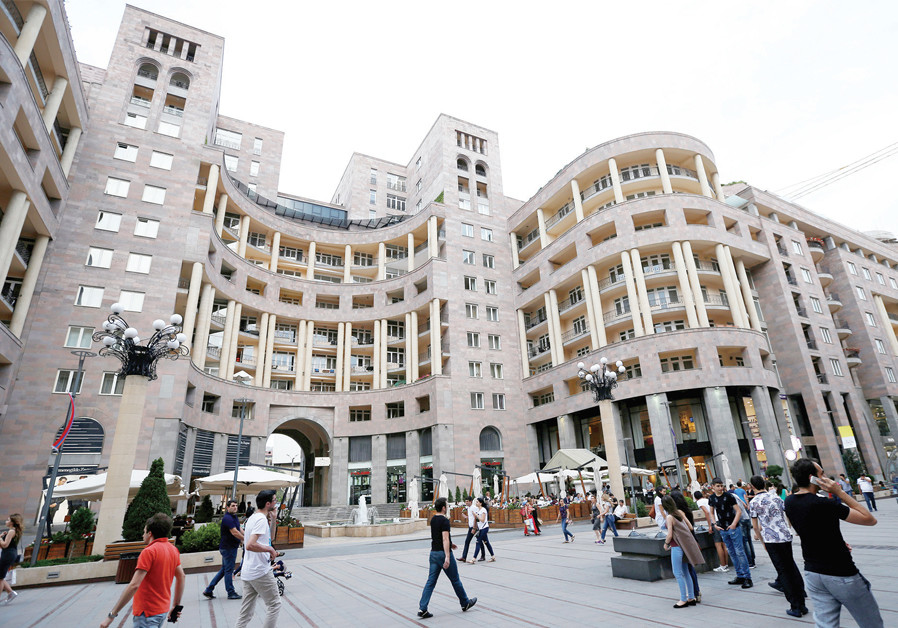
    ‘DIFFERENT FROM our neighbors’: Armenia today.. (photo credit: Courtesy)
    The scourge that famed historian Robert Wistrich once described as “the longest hatred” is undergoing a frightening contemporary resurgence. From synagogue shootings in Pittsburgh and Poway, which grabbed global headlines, to lesser-known but near daily reports of vandalism, threats and violence, the 21st-century revival of antisemitism is unmistakable.

    While most attention – justifiably so – focuses on growing antisemitism among the far Right, far Left and Islamic extremists, one traditional source of Jew-hatred has been largely overlooked: Christian antisemitism.
    This past week’s report that an antisemitic attack was carried out earlier in June by 60 Armenian Church students on the eve of the Shavuot holiday in Jerusalem brings to light the centuries-old trend of Christians targeting Jews, and in this case the ongoing antisemitism in Armenia. Beyond that, the incident represents a cautionary tale for both Jewish leaders and the Israeli government as they seek to build global partnerships and alliances.

    With major reforms in the Catholic Church (such as Vatican II) that ended centuries of antisemitic teachings, as well as the burgeoning movement of Christian Zionism found especially within the Evangelical community, it is easy to presume that Christian antisemitism is on the wane.

    On a parallel track, given the threat of Islamic terrorism and the tensions of the Arab-Israeli conflict, it is usually a safe assumption that Israel will have stronger alliances with Christian-majority nations than Muslim-majority states.

    But facts on the ground occasionally dictate otherwise – particularly in Armenia, one of the world’s oldest Christian nations.

    There is abundant evidence of Armenian society displaying systemic antisemitism, including high-profile research conducted in recent years. In 2018, a Pew Research Center survey found that 32% of Armenians would not accept Jews as fellow citizens. The Anti-Defamation League’s (ADL) latest “Global 100” study, meanwhile, found that a majority of Armenians believe a variety of antisemitic stereotypes are “probably true.”

    Furthermore, despite the establishment of diplomatic relations shortly after Armenia gained independence in the early 1990's, ties between Israel and Armenia remain woefully underdeveloped – especially compared to Israeli ties with Armenia’s Muslim-majority neighbor, Azerbaijan.

    Israel’s deep relationship with Azerbaijan is no accident. Azerbaijan has no history of antisemitism (and no contemporary antisemitism, for that matter), a prosperous Jewish community of its own for over two millennia, and a thriving immigrant community in Israel.


    HOW IS it possible that a Muslim nation has warm ties with the world’s only Jewish state, while a Christian country like Armenia is plagued by antisemitism and frosty relations with Israel?

    First, one must consider the broader environment of religious tolerance in Azerbaijan, which is rooted in proper separation of church and state. In a Gallup International/WI Network of Market Research poll, Azerbaijan ranked as one of the most secular nations among 65 countries surveyed. Azerbaijan’s population is 97% Muslim, but the country’s constitution affirms the country as a secular state. The state education system is secular. It is a tremendous statement in support of religious freedom for an overwhelmingly Muslim population to avoid designating any official state religion.

    Contrast that with Armenia, where the Armenian Apostolic Church holds significant influence. In the fourth century CE, the Kingdom of Armenia became one of the first states to officially adopt Christianity. The sway that the church holds over the Armenian state continues to this day. The Armenian Apostolic Church holds official status as the national church, despite the fact that Armenia’s Law on Freedom of Conscience establishes the separation of church and state. As such, Armenia is not a purely secular state like Azerbaijan.

    At the same time, there is ongoing concern over vestiges of ancient church-based antisemitism, particularly in Eastern Orthodox churches. The ADL has called on these churches to remove ancient antisemitic passages in their liturgy and to end the teaching of replacement theology.

    Given the central role the Armenian Church still plays in the country, it is perhaps no surprise to see Armenia whitewashing Holocaust history on the state level, Armenian media showing consistently anti-Israel and antisemitic tendencies, and most recently the antisemitic attack by Armenian Church students in Jerusalem. Without authentic separation of church and state, religiously motivated bias and hate have greater potential to fester among a country’s population.

    The contrast with Muslim-majority, yet secular Azerbaijan could not be starker. Azerbaijan has consistently stood up against antisemitism, maintains close defense and economic ties with Israel, and is a bulwark against the threat of Iran.

    Jewish and Israeli leaders must keep this historic and present-day context in mind. Don’t judge a nation by its predominant religion. Although conventional wisdom on sources of religious hatred often holds to form, allies can still be found in unexpected places.


    The writer is an author and journalist. His memoir and social critique, The Egotist, has been translated into five languages. His work has been featured in The Daily Caller, MSN and The Huffington Post. His book of articles, Tikkunim (Corrections), was released in January 2018.
    Join Jerusalem Post Premium Plus now for just $5 and upgrade your experience with an ads-free website and exclusive content. Click here>>

    Prosecution drops charges against Palestinian accused of raping Israeli girl

    Prosecution drops charges against Palestinian accused of raping Israeli girl

    After 55 days in custody, during which ministers called for his execution, Mahmoud Qadusa to go free due to insufficient evidence

    Illustrative: Orthodox girls arrive at their school. (Flash90)
    Illustrative: Orthodox girls arrive at their school. (Flash90)
    The Israel Defense Forces’ military advocate general announced Tuesday morning that he was dropping the charges against a Palestinian man accused of brutally raping a seven-year-old Israeli girl.
    The indictment against Mahmoud Qadusa had come under fire for its apparent lack of evidence, a fact that the military prosecutor, Sharon Afek, acknowledged in a statement to the press announcing the annulment of the charges.
    The statement said that “the evidentiary infrastructure that underlies the indictment does not at this time amount to a ‘reasonable chance of conviction.’ Therefore, by law, the criminal process cannot continue, the indictment must be withdrawn and Qadusa released from custody.”
    The MAG’s announcement was released hours before a military court was scheduled to hold a remand hearing for Qadusa.
    The suspect’s lawyer said the decision was “better late than never,” but blasted the court for having allowed his client to remain in jail for nearly two months. He is slated to be released later on Tuesday.
    Qadusa, a 46-year-old maintenance custodian at the alleged victim’s school in an ultra-Orthodox settlement in the central West Bank, was arrested 55 days ago.
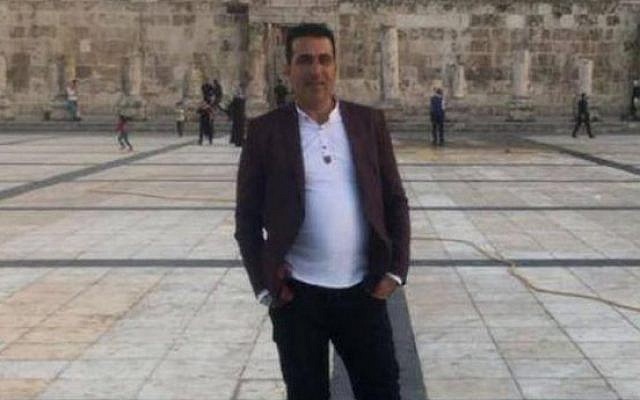
    Mahmoud Qadusa (Twitter)
    According to the dropped charges, sometime “between the months of February and April” Qadusa dragged the girl from her school to a vacant home in the settlement, where he raped her as at least two of his friends pinned her down.
    Police kept the case under gag order until after they had filed the indictment last Sunday. The charges were met with a flurry of posts on social media that concluded the crime had been an act of terrorism due to the fact that the suspect was a Palestinian.
    Several right-wing lawmakers called for Qadusa’s execution.
    But days after the indictment was leaked, police came under fire for relying almost entirely on the testimony of the seven-year-old victim, forgoing forensic evidence in addition to being unable to determine the exact date that the alleged crime had taken place.
    Last week, police announced that they were reopening the investigation in order to verify the suspicions against Qadusa.
    On Monday, an official with knowledge of the investigation confirmed that an additional slew of details had called further into question the level of professionalism with which the probe had been conducted.
    More than two months since the rape was believed to have taken place, only on Monday did police arrive at the home of the alleged victim to collect her clothes for DNA testing, the official confirmed, adding that detectives were skeptical as to whether any forensic evidence could be found.
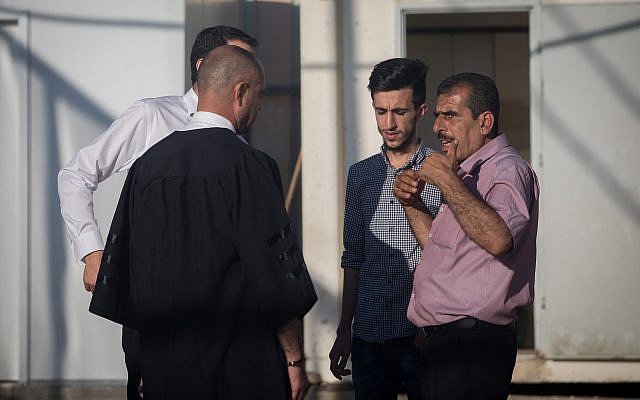
    Attorney Nashaf Darwish (L) speaks with the brother and son of Mahmoud Qadusa, a Palestinian man charged with kidnapping and raping a 7-year-old Israeli girl, at the Judea Military Court in the West Bank on June 19, 2019. (Yonatan Sindel/Flash90)
    The official also confirmed that the seven-year-old girl was only able to ID Qadusa in school after her mother pointed at him first and told her he was the man who had raped her.
    Moreover, a failed polygraph test cited by the military court in successive decisions to extend Qadusa’s arrest was carried out in Hebrew, rather than the defendant’s native Arabic, the official said.
    “This case tells us a lot about how the legal system operates with regard to Palestinians on the other side of the Green Line,” said Qadusa’s attorney Nashef Darwish. “I listen to the words of the military advocate general and I say to myself, if this is the situation, why now? Why did they not do it a week ago?”
    “I do not feel that a pedophile was released because of police failures. I feel that an innocent person was held in detention for almost two months because of extraneous considerations, because of excessive zeal and nothing more,” he added.
    Tal Gabay, one of the two lawyers representing the seven-year-old’s family, maintained that Qadusa was the culprit and said he found it “disturbing” that due to “mishaps in the police’s investigation, the rapist [will] be allowed to roam freely.”
    Afek, the military prosecutor, said Tuesday that the investigation would continue, “both in relation to Qadusa and following additional leads,” and did not rule out an eventual indictment against the suspect.
    READ MORE:

    Bombshell: Google Exec Caught on Hidden Camera Reveals Meddling in 2020 Elections


    Bombshell: Google Exec Caught on Hidden Camera Reveals Meddling in 2020 Elections

      
    5779
     
    0
    15
    This should rock the foundations of the hi-tech world. Google should be punished, if not by the government then by the public. This is outright premeditated meddling by Google to influence the upcoming elections and stop President Trump from being reelected.

    Where is the outcry? It is finally being exposed by Google employees themselves!
    Already two years ago it was clear to me that this was happening. I called it the post-Trump election purge. Right after the 2016 elections, hi-tech executives at Google, Facebook and Twitter were issuing comments blaming themselves for Trump’s election win. Why were they blaming themselves? Because they said that they “allowed fake news” to spread to spread and it was based on the fake news that people voted for Trump. Now listen to the full video about the Google expose and don’t miss the Google insider explain how Google manipulates the search algorithm so people won’t find links for Hillary Clinton emails, because Google deemed it a conspiracy theory! Who allowed Google to decide for the whole world what is a conspiracy or not and to judge that it should be “hidden” from the public?
    This is just the tip of the iceberg of what Google, Facebook and Twitter are doing to censor conservative voices, videos, accounts etc. in order to shape the public discourse and harm Trump’s chances of reelection.
    We have experienced this with our accounts that share the truth about Israel and the dangers that jihadi/sharia Islam pose to the freedom loving world.
    Whether one is a Trump supporter or not, this is an extremely scary development that should shock everybody. Self appointed “social justice warriors” are deciding for the whole world what we should see and listen to.
    This must be stopped ASAP! If the government doesn’t stop it, then we the people must make our voices heard and stop using these platforms. It is not easy, but that is the only way to stop them from controlling our future.

    Full Expose with Google Insider Revealing All

    (of course youtube removed the video! Project Veritas created back up options)
    BREAKING: Google insider admits YouTube routinely suppresses PragerU videos.
    PragerU issued the following message today in response to this bombshell video where a Google Insider names PragerU as targeted for censorship by Google/YouTube:
    A shocking new video released today exposes how Google/YouTube routinely uses its algorithm to suppress conservative content, namely videos from PragerU and Dave Rubin.
    A Google insider told Project Veritas that PragerU videos receive “heightened analysis,” and the artificial intelligence program, Viacon, polices distribution singling PragerU videos out, among others.
    This is deeply concerning.
    As the exposé reveals, Google is manipulating its algorithms to suppress content specifically from conservatives. Instead of being a platform for all ideas, as it claims to be, Google is now becoming the arbiter of truth, preventing millions of Americans from seeing content that presents a conservative point of view.
    This is pure bias, and a step towards eliminating the freedom of speech online.
    YouTube/Google currently restricts over 100 PragerU videos, labeling them as “dangerous” and, at times, derogatory content. The tech company also prevents PragerU from monetizing many videos.
    However, we are fighting back.
    PragerU has a court date in our lawsuit against Google scheduled for August 27th in the Ninth U.S. Circuit Court of Appeals. The outcome of this case is critical, and it will determine the future of the freedom of speech online for conservatives.